INBDE Case-Based Questions: How to Read the Patient Box
The cornerstone guide to INBDE case-based questions: Patient Box mechanics, read-question-first tactics, distractor data, negative stems, and the answer that treats the patient.
INBDE Case-Based Questions: How to Read the Patient Box
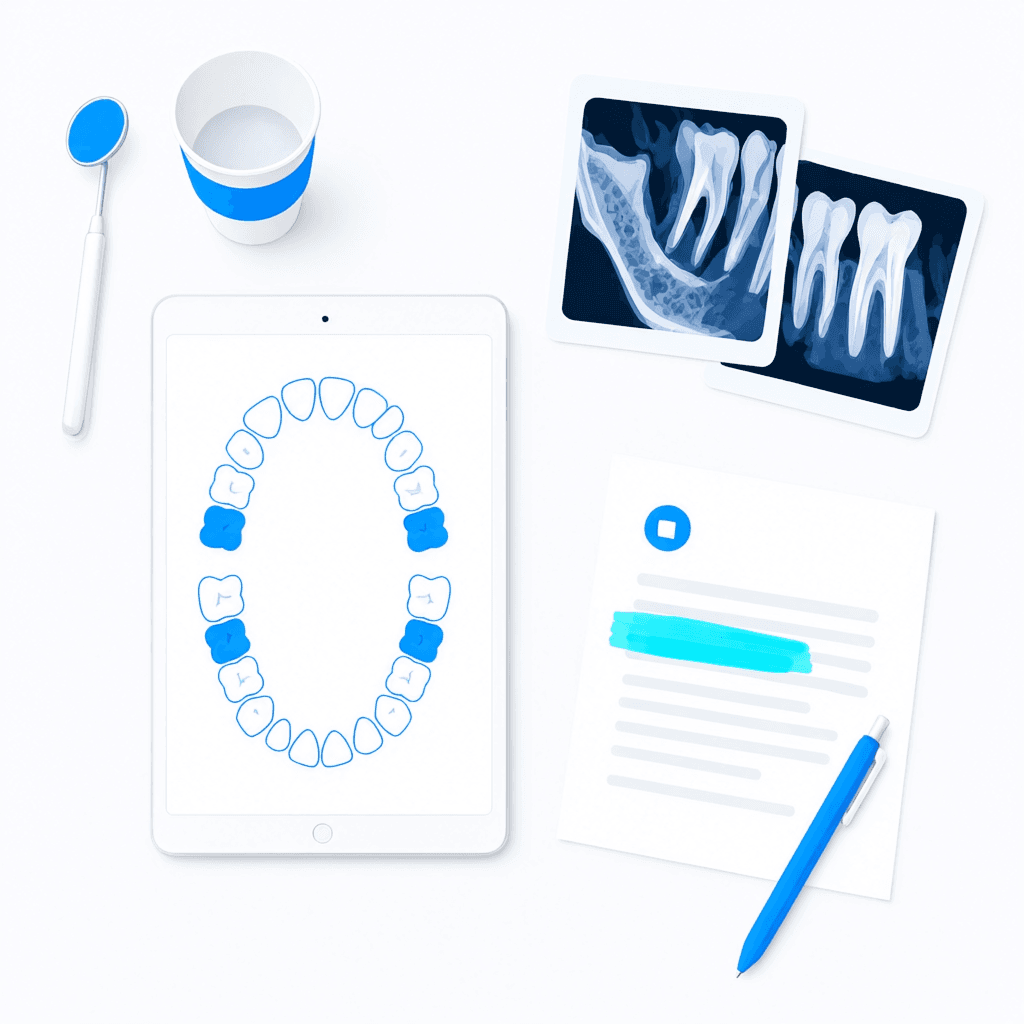
Case-based questions are the most different part of the INBDE from school exams. About 40% of the exam is case-based, including all of Day 2. Each case starts with a Patient Box that may include dental charts, radiographs, and photographs. We have watched students waste minutes on irrelevant data because they opened the Patient Box before reading the question. The students who struggle are usually the ones who treat the Patient Box like a textbook chapter instead of a clinical chart.
Patient Box Mechanics
The Patient Box presents the information available at the visit. It may include:
- Medical history and medications
- Vital signs
- Dental charting
- Radiographs and photographs
- Chief complaint and findings
A blank field means the information is unknown or unavailable. It is not a trick. The exam wants you to reason with incomplete information the same way you do chairside. Cases have 2-5 items each, and single-stimulus and comprehensive multi-image cases both appear.
The information in one item may support another. If the first question asks about the diagnosis and the second asks about management, the answer to the first often constrains the second. Read the full case carefully, but do not read the whole case before you know what the question is asking.
Read the Question First
This is the single most important case strategy. Read the question stem first, then open the Patient Box. Often you can identify what you need before you wade through the distractors. The radiograph might be irrelevant; the bisulfite allergy might be the hinge.
Reading the question first prevents you from drowning in data. The Patient Box is designed to look like a real chart, which means it contains noise. The question tells you which signal to look for. Students who adopt this habit consistently report that they finish cases faster and with fewer fatigue errors.
The Patient Box Is a Chart, Not a Story
The exam does not give you a narrative. It gives you a chart. Real charts are messy. They have missing fields, irrelevant findings, and conflicting priorities. Your job is to extract the clinical answer, not to construct a coherent story.
If you find yourself inventing backstory to justify an answer, stop. The answer must come from the data provided. Blank fields are not clues; they are simply unknown information. Reason with what you have, not with what you wish you had.
Distractor Data
Patient Boxes contain deliberate distractors. A perio chart and blood pressure reading may look important, but the real clue may be an allergy or a medication. Practice distinguishing signal from noise. Students report that some radiographs are sub-diagnostic and hard to zoom, so practice interpreting imperfect images.
The most common distractors are normal findings framed as abnormal, irrelevant radiographs, and vital signs that do not change management. The hinge is usually an allergy, a medication, a pregnancy status, or a comorbidity that changes the standard of care.
Trap Stems: EXCEPT, NOT, LEAST
Capitalized negative stems are common. They reverse the task:
- "All of the following are appropriate EXCEPT" means three options are correct and one is not
- "Which is NOT indicated" means the right answer is the thing you should not do
- "LEAST likely" means the rare answer
Read these stems twice before you look at the answer choices. A negative stem with a management question is one of the highest-error formats on the exam. Many students read the stem once, select the answer that would be right for a positive stem, and move on without catching the reversal.
Qualifier Words Change Everything
Look for words like "initially," "most appropriate," "at this time," and "next step." These qualifiers flip the correct answer. The best antibiotic for a healthy patient is not the best antibiotic for a pregnant patient with a penicillin allergy. The most appropriate next step is not the same as the eventual definitive treatment.
Train yourself to flag the qualifier before you read the options. The qualifier is often the only thing that separates two defensible answers. Two options may both be clinically correct, but only one answers the exact question asked.
The Answer That Treats the Patient
On management questions, the best answer is usually the one that treats the patient, not the one that treats the disease in isolation. That means considering allergies, comorbidities, pregnancy status, and patient preferences. The autonomy-over-beneficence default is strong: the patient's stated wishes win unless an imminent safety issue exists.
Educate, do not abandon, when a patient refuses treatment. Answer as the ideal practitioner, not as what you might do chairside. The exam rewards the textbook standard of care filtered through patient autonomy. The answer that treats the whole patient usually beats the answer that treats the disease.
The Integration Challenge
A single case may weave together pharmacology, microbiology, pathology, and ethics. A patient with a bleeding disorder, on warfarin, with a dental infection is not just a pharmacology question. It is also a hemostasis question, a management question, and possibly an informed-consent question. The INBDE tests integration, not silos.
School exams often separate subjects. The INBDE does not. You must be ready to move across disciplines inside a single vignette. The best preparation is a question bank that mirrors this integration with realistic case sets.
Common Case Patterns
Students consistently report that certain patterns recur across forms:
- Prosthetic cases that ask about RPD design and occlusion
- Emergency cases that ask about avulsion, fracture, or irreversible pulpitis
- Medically complex cases that hinge on an allergy or anticoagulant
- Ethics cases that test autonomy and informed consent
- Pediatric cases that blend behavior management with clinical decisions
Recognizing the pattern does not give you the answer, but it tells you where to look. It also helps you anticipate the kind of distractors the case will include.
Patient Box Workout Strategy
Treat every Patient Box like a chart review. Before you answer, ask:
- What is the safety issue?
- What is the patient asking or refusing?
- What medication or allergy changes management?
- What image is actually relevant?
This structured scan prevents you from missing the hinge detail. Run this checklist on every case during practice until it becomes automatic. On test day, it will save you from distractor traps and missed qualifiers.
What to Do When You Are Stuck
If you cannot find the hinge, eliminate the answers that are clearly wrong and choose the one that best fits the patient. Do not leave items blank: there is no penalty for guessing. Flag and move on if you are spending too long. First instinct is usually better than a tired re-analysis.
Remember that some items are unscored experimental items and may look weird by design. Do not let three bizarre questions rattle a whole section. Treat every question as scored, but do not let one odd item destroy your pacing.
Form Variance Warning
No two candidate forms are identical. One student may see a Day 1 heavy in pharmacology and ethics; another the same week may see a different mix. This means full blueprint coverage is the only safe prep. Do not guess topics based on one friend's report.
The case-based format means you cannot rely on topic spotting. A form that is light on pharmacology standalone questions may still test pharmacology inside Patient Box cases. Full coverage across 56 Clinical Content and 10 Foundation Knowledge areas is the only hedge.
How to Review a Missed Case
When you miss a case, do not just read the correct answer. Write down:
- What was the hinge?
- What distractor did I fall for?
- What qualifier did I miss?
- What would I do differently next time?
This turns one missed case into a reusable pattern. The students who improve fastest are the ones who review their errors systematically, not the ones who simply log more questions.
How to Train with a Case-Based Question Bank
A large case-based question bank is the closest thing to test day. We built Crack the Dental Boards with 7,000+ INBDE questions including case-based items, with detailed explanations for every option. Use the bank to practice question-first reading, train signal-from-noise discrimination, drill EXCEPT, NOT, and LEAST stems, and build tolerance for sub-diagnostic radiographs.
Review every explanation, especially for the wrong options. The wrong-option rationale is where the case craft becomes visible. The more cases you work, the faster you will recognize the hinge and ignore the noise.
How to Practice Question-First Reading
Question-first reading is a habit, not a one-time trick. Practice it on every case in your question bank. Cover the Patient Box, read the stem, identify what you need, then uncover the box. After a few dozen cases, the habit becomes automatic.
The most common mistake is opening the radiograph because it looks interesting. Train yourself to ask why the image matters before you look at it. If the question is about management, the image is often confirmatory or irrelevant. If the question is about diagnosis, the image is usually the key.
The Role of Pharmacology in Cases
Pharmacology rarely appears as a simple drug-name question. It appears as a patient on warfarin who needs a dental extraction, or a patient with a penicillin allergy who needs an antibiotic, or a pregnant patient who cannot take certain medications. The drug is the hinge, but the case is about management.
When you review pharmacology, always ask what would change if the patient were pregnant, elderly, had renal disease, or had an allergy. This is the mindset the INBDE tests.
How to Build Speed on Cases
Speed on case-based items comes from pattern recognition, not from reading faster. The more cases you complete, the faster you recognize the hinge. Aim to complete a fixed number of case items every day, even when you feel slow. Consistency builds the mental shortcuts that save time on test day.
Time yourself on case blocks and review where you slow down. If you spend too long on the Patient Box, you are probably reading before you know the question. If you spend too long on the options, you may be missing a qualifier. Targeted practice fixes both problems.
INBDE cases reward question-first reading, patient-level reasoning, and careful handling of negative stems. The Patient Box is a tool, not a trap. Use a large case-based question bank to train pattern recognition, build speed, and review every wrong-option explanation. Remember that the answer that treats the whole patient usually beats the answer that treats the disease.
Ready to crack the iNBDE?
Crack the Dental Boards gives you 6 full-length iNBDE mock exams, 7,000+ exam-style questions, 70+ hours of video crash courses, 100,000+ flashcards, and a complete study engine: Adaptive Quiz Generator, Adaptive Flashcard Generator, AI Tutor, Homework Helper, YouTube Summarizer, and Study Schedule Creator. Everything is aligned to the official iNBDE blueprint and comes with unlimited tokens, unlimited credits, no throttling, unlimited access, and unlimited usage. No subscriptions, no usage caps.
No credit card required for the free trial. One-time payment for full access.
Related articles
INBDE High-Yield Topics: What to Study by Blueprint Weight
The high-yield INBDE topic list organized by blueprint weight: Oral Health Management, Diagnosis and Treatment Planning, Practice and Profession, and Foundation Knowledge priorities.
Section GuidesINBDE Pharmacology Review: Local Anesthetics and Drug Interactions
A focused INBDE pharmacology review: carpule math, max doses for lidocaine, articaine, mepivacaine, and bupivacaine, epinephrine limits, and med-history mining for interactions.
Section GuidesINBDE Oral Pathology and Radiology: A Section Guide
The INBDE embeds oral pathology and radiology across both days. Master recurring lesion patterns, practice imperfect radiographs, and drill SLOB-style landmarks until interpretation is automatic.
Turn strategy into a passing iNBDE score
6 full-length iNBDE mock exams, 7,000+ questions, 70+ hours of video, and unlimited AI tools. Start today.
Unlock Everything